Wednesday, 16 May 2007

Spring Days on the Riverbank

The River Ribble and riverside Green Belt in Penwortham and Preston has erupted in all its Spring glory... and we've spent more time down by the river than sitting indoors blogging it!

If you fancy spending a day on the riverbank, see Ribble Events...

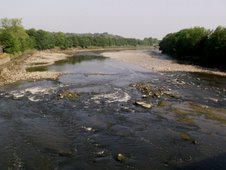
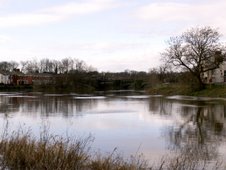
From February onwards, when the trees were bare and the scene from Penwortham Old Bridge at low tide was still very wintry, even in the unseasonably warm sunshine...


...and in March the Penwortham riverbank, and meadows and woodlands seen across the sparkling Ribble waters from Avenham and Miller Parks still wore their winter aspect...


... but by April the trees lining the river are definately springing forth, marking much more of a colourful contrast with the huge amount of rich brown silts flowing downriver to feed the Ribble Estuary's mudflats and saltmarsh - and the vast numbers of birds beginning to breed there.


Throughout March and April the buds burst out all along the river and in the woods alongside...


...until the end of April finds the trees suddenly rich with all shades of green, the riverside allotments on Penwortham Holme suddenly shooting leaves and new growth to repay all that hard work (although the hardest work is now beginning!), and football becomes a much more pleasurable activity to both play and support in the warm Spring sunshine (but especially if your team is winning!)


The River Ribble endlessly passes by, and it is a deep pleasure to spend time by the river, every season, every weather, every stage of the tide. Whether low tide, high tide, or somewhere inbetween, the Ribble is ever-changing, depending on the weather, the light, the amount of water running downriver or coming up with the tide, and the amount of silts the Ribble's waters take with them.

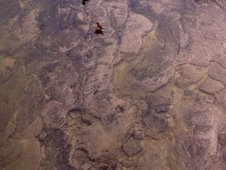
Here, it is a very low tide in April, due to the unseasonably low rainfall in early to mid-Spring (which the wet and cold weather appears to be making up for now in May!). The sunlight shines through the waters and shows the beautiful patterns of the riverbed below the Tram Bridge and the lightly flowing silts making their way downstream in the warm Spring sunshine...


... so warm, indeed, that spending time by the river includes messing about on the water - regardless of where the tide happens to be as the Ribble has been navigated for hundreds - indeed thousands - of years, and all without recourse to a barrage. These leisurely anglers are happy to lounge in the beautiful late April sunshine at low tide inbetween Penwortham Holme and Broadgate... probably waiting for the tide to come in and carry them gently back upriver again rather than spend too much energy rowing!


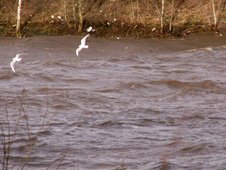
Nothing can beat the sound of the Ribble's waters racing over the stones and rivermud at low tide...


...unless it's coupled with the sounds of the birds singing in the meadows and woodlands alongside as May brings blossom, rich greens of every shade, and the birds in full voice... BLISS....


The Ribble's riverside Green Belt and floodplain areas are a beautiful and irreplaceable habitat for birds, insects, mammals, flowers, trees, grasses, and local people!


There are some fabulous trees along the Ribble, bordering the riverside meadows, and throughout the many copses and woodlands here, not just the famous Elms along the Tram route and along the river's edge through Miller Park, but Beech and Oak, Willow and Plane, Rowan and Poplar...


The famous Elms lining the old Tram route through Penwortham to Lostock Hall.


May brings full Spring growth in Avenham and Penwortham, its full glory reflected in the waters of high tide: the macrocosmic view...

...and the microcosmic...

Bluebells in riverside woodlands in Penwortham...


Ribwort Plantain on the riverbanks...


White Clover...

and Red...


plus...

Forget-me-nots on the Penwortham riverbank...


Red Campion nearby...


...and a Speckled Wood butterfly on an Oak sapling.


The May Blossom on the Hawthorn is as thick as snow...


...and Birds-Foot Trefoil shines out in the meadows.


The lush greenery of the riverside trees is reflected in the still waters of high tide whether near...


...or afar.

Low tide looks equally glorious...


...the light and the Ribble's waters ever-changing...


...showing beauty wherever you look, whether from Penwortham towards the Tram Bridge and Avenham at low tide...


...or from Avenham and Miller Parks towards the Penwortham riverbank as high tide recedes...


...and on the river itself, low tide brings a wealth of wildlife...


...eager to feed in the Ribble's rich mudflats...


...and the evening light reflected in the Ribble's waters has its own beauty - but it's a pity the newly-returned screaming Swifts are way too fast for my camera as they swoop low over the water catching their tiny-winged supper -

- and the returning House Martins scoop beakfuls of riverbed mud at low tide to reconstruct their nests for this Spring's broods under our eaves.


Spring has returned to the Ribble.

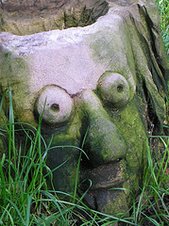
And all the while, through all seasons, all weathers, and all tides, an ancient face winks from the Ribble riverbed beneath Penwortham Old Bridge...


Contact savetheribble@tiscali.co.uk

Friday, 20 April 2007

Two Spring Evenings at Marshside

This Spring, we went downriver to Marshside on two evenings in the same week - and yet they couldn't have been more different.
Marshside Mist.
The first had been a very foggy day, which hadn't cleared by the afternoon, and this wilderness landscape seemed quite eerie disappearing into the mist on all sides. We heard far more birds than we saw today, not surprisingly.


The Marshside saltmarshes include many creeks and wetland grasses.

It was a nice opportunity to experience the sounds of the saltmarshes more than the sights as vision was often very limited when the mist was thick... although it was quite disorientating when the mist was at its thickest, and the sounds of the birds - particularly the Redshank with their unsettling echoing cry - suddenly calling out quite close by was very atmospheric.


The creeks are still full, and the eerie cries of Redshank sound like lost souls echoing across this misty wilderness.

As you walk further out, or along the edge towards Southport, the saltmarsh gives way to the mudflats on all sides. It seems even more of a wilderness with only the treacherous mud underfoot and only the sounds of the birds for company.


There are many creeks snaking their way across the mudflats, looming through the mist as it thins occasionally.
We feel we have walked into misty isolation and the unstable mudflats underfoot far enough and turn back to Marshside. The visitor centre hide is closed for the evening but the views across the lagoons from the open hides are well worth the trip, whether or not you feel like braving the walk out onto the estuary itself.


The Marshside lagoons fading into the mist look never-ending. The more time you spend looking across the lagoons and marshes here, the more birds you see. When a huge flock takes flight you realise that you had been looking directly at hundreds - if not thousands - of birds without seeing them!


Huge flocks of birds will suddenly rise up from the saltmarshes and grasses right in front of you - and you hadn't even realised they were there!

If you haven't got any binoculors, try visiting the Visitor Centre hide at Marshside during opening hours as the birds are up really close and the staff at the centre always have fabulous telescopes to look through too.


The lagoons are beautiful, these reeds and grasses reflected in the waters. This was also going to be a picture of a Little Grebe but it dived under the water at the right of the picture a second earlier!


Pink Footed Geese on the lagoon.


Not shy!

Most of the Pink Footed Geese are either still out on the Estuary mudflats - in the mist! - or have already left for their breeding grounds in Iceland for the summer months. We want to see them coming in to Marshside from the Estuary mudflats at sunset to roost, so we plan another trip for later that week - and hopefully NOT a misty one...

Marshside Sunset.
Our second trip couldn't have been more different - and only a few days apart. It seemed like a completely different season. The sun was warm and golden in the late afternoon, casting the saltmarshes into a golden landscape - although the inevitable cold wind was still blowing inland from the Estuary so we were glad of our fleeces but regretting the gloves and scarves optimistically left behind...


The new dusty-green shoots of the marsh plants are visible through the gold of last year's growth when you get up close, but the landscape view is fantastic! And it SOUNDS even better than it looks - there are so many Skylarks here at Marshside, their beautiful songs turn the air to gold as much as the sun does - it's a pity the photographs can't transmit sound!


Plants are flowering all over the saltmarsh.


As evening approaches, the saltmarsh begins to take on a golden tinge.


The light reflecting from the wet mud and creeks as the sun begins to get lower in the sky is dazzling, and many of the birds begin to fly inland to find a roost for the evening.

We wait with bated breath for the mass of the Pink Footed Geese to fly inland to roost on the lagoons and marshes behind the Estuary...
We wait for a long time, hands getting colder by the minute. What we did see was surprising -


No, it's not Crosby beach, that really is a man out there, far away on the distant horizon, watching the many thousands of birds out on Marshside's intertidal flats at low tide. It's always a good idea to make sure the tide is on the way out if thinking of venturing out onto this area, and that you know exactly where you're going!


This is as far as we dare venture at Marshside - and then only when we're doubly sure the tide isn't due in for several hours. It's quite unnerving being out here this far if you suddenly think that you may have misread your Tide Table and put the summer-time hour adjustment the wrong way...
The RSPB hide a few yards down the road from the car park (at the old sand works) has the tides written up on the board outside so you can easily check here first.

If in doubt, don't go out!

As the light darkens to dusk, we decide to walk back to the marshes and lagoons inland to watch for roosting birds. The cries of the Redshank and twittering song of the Skylarks show no sign of abating, accompanying our walk back to the hides at Marshside.


Thousands of the Ribble's birds fly in from the Ribble mudflats to roost on the lagoons and marshes at Marshside. If you click on the picture to enlarge it, you'll see hundreds of birds roosting on the marsh.
We wait but there's no sign of the Geese - on their way to Iceland we suspect! They probably left this morning, as it's been such a glorious day!


The sun slowly sinks to the horizon and reflects on the distant Ribble, miles away across the Marshside mudflats.


It's turning into a fantastic sunset...


A Kestrel hunts for supper right in front of us as if we weren't there!


Well worth freezing for - that wind can be SO cold blowing across Marshside from the sea, especially once the sun loses height...


Glorious...!

We'll have to wait until Autumn for the flocks of Pink Footed Geese to return, but we'll be back to hear those Skylarks throughout the summer months as they breed on the saltmarsh - Marshside is the best place for Skylarks in Lancashire, so go along and enjoy their golden song.

Wednesday, 4 April 2007

Sustainable Development and Wetlands

Sustainable Development.
If sustainable development is ‘development that meets the needs of the present without compromising the ability of future generations to meet their own needs’ (World Commission on Environment and Development 1987), and that this necessarily includes the environmental sustainability of a development, it is useful to examine what this means for the River Ribble.


Local policy is informed by British Government policy, which uses the same criteria for Sustainable Development targets, and adds:

‘Natural resources are vital to our existence. Our health and well-being are closely linked to the quality of our air, water, soils and biological resources. Our landscapes, seascapes and wildlife are inseparable from our culture and inspire art and literature. Our economy and key industrial sectors are directly and indirectly reliant on functioning ecosystems. Many people believe that natural resources have their own intrinsic value, that is, they are important for their own sake regardless of their functional value.

Defra are working within this same remit for Sustainable Development, and their aim in their development of the Ecosystems Approach Project is to explicitly draw on the global Millenium Ecosystem Assessment (MA).

The Millennium Ecosystem Assessment assessed the consequences of ecosystem change for human well-being. From 2001 to 2005, the MA involved the work of more than 1,360 experts worldwide. Their findings provide a state-of-the-art scientific appraisal of the condition and trends in the world’s ecosystems and the services they provide, as well as the scientific basis for action to conserve and use them sustainably.

The MA Statement on Wetland ecosystems reads:

‘Wetlands perform a wide range of functions of great value to people – from acting as a natural pollution filter and preventing floods by storing water during heavy rains to supporting wildlife and recreation’ (Sec 2:0, p11). As such, ‘the net benefits from the more sustainably managed ecosystem are greater than those from the converted ecosystem when measurements include both marketed and nonmarketed services, even though the private (market) benefits would be greater from the converted ecosystem’ (p11).
This means that the more obvious commercial interests, and the economic benefits accrued as a result of converting ecosystems (by barraging an intertidal river or estuary, say) will be outweighed by the economic losses in the long term. This is precisely the case with Cardiff, of course.

The global status of wetlands, assessed by the Millenium Ecosystem Assessment, are depleting due to development, and as such, form increased risks to human sustainability in the ‘loss of natural buffers’ on a number of levels (Sec 2:17, p19):

‘The loss of wetlands combined with increased pollution has reduced the ability of natural systems to cleanse water supplies, with major implications for human health and fisheries’ (20).

‘While wealthier economies can more easily afford engineered alternatives to natural services, such as artificial flood defenses to compensate for the changes made to river banks and wetlands, the cost of such measures can place a heavy burden on public expenditure. Investment in measures to conserve the original function of these natural spaces is generally a far cheaper and highly effective option’(Section 2:20, p22).

The MA’s “Wetlands and Water” Synthesis is a detailed Report, ‘prepared to provide Contracting Parties to the Convention of Wetlands (RAMSAR, Iran, 1971), and all those responsible for and involved in implementation of the Convention and concerned with the future sustainability of wetlands and water, with a synthesis of the findings of the Millenium Ecosystem Assessment’
(Millenium Ecosystem Assessment 2005, Ecosystems and Human Well-Being: Wetlands and Water Synthesis, World Resources Institute, Introduction).

It reads:
‘It is well established that coastal ecosystems such as mangroves, coral reefs, tidal flats, and estuaries are experiencing degradation and loss’ (W&W, p.25, original emphasis).

‘Coastal wetlands… contain some of the most productive [wildlife] communities in the world’ (26), and there is ‘increasing evidence of a rapid and continuing wide-spread decline in many populations of wetland-dependent species… including molluscs, amphibians, fish, waterbirds, and some water-dependent mammals… [the] overall… trend in vertebrate species populations… shows a continuous and rapid decline in freshwater vertebrate populations… [while] invertebrates… species are significantly threatened with extinction’ (26-7).

Whilst the list of threatened and declining wetland wildlife species is long and depressing, the Report also goes to great lengths to examine the vital importance to human communities of wetland ecosystems – this is, in fact, the central role of the Report.

Our Wetlands provide, manage, and regulate fresh water, food, flood defences, nutrient cycling, groundwater regulation, pollution control, climate regulation (a complex system including regulation of greenhouse gases, temperature, and precipitation) (see p.31 of W&W for more details of what each criteria involves), and of course, ‘wetlands have significant aesthetic, educational, cultural, and spiritual values and provide invaluable opportunities for recreation and tourism’ (30).

Read more about Wetlands and Water, and the Millenium Ecosystem Assessment.

The Ribble Coast & Wetlands Regional Park provides us with an alternative vision for the present and future of the Ribble corridor, and one which is sustainable in environmental and economic terms – and doesn’t involve changing the appearance or the dynamic ecosystem of the Ribble and its Green Belt and Floodplain, but instead, relies on its ecological importance to provide excellent amenities for local people and tourists alike… it is estimated that new visitors to the Ribble Wetlands will generate £115 million EVERY YEAR – and of course, will cost a lot less than a barrage to maintain!

You can contact Reigh Belisama at savetheribble@tiscali.co.uk